A leading digital music distribution platform (name withheld for privacy) launched an artificial intelligence development seminar aimed at building AI-based solutions capable of identifying promising music artists. The company seeks to sign artists who:
Will generate enough future streams to be profitable, which translates to annual streams above 500 thousands.
But not too many, so they do not attract major labels and investors, which translates to annual streams below 20 millions.
Target Range: 500K - 20M annual streams Fewer than 500K = too risky | More than 20M = too competitive
Data Source:
We utilized the Viberate private API to automatically gather data for thousands of artists. Our focus was exclusively on Spotify data (amongst many other music plateforms gathered from Viberate) due to its richness and relevance in the music streaming ecosystem.
Data Input: Streams Weekly — selected for its relevance to this approach.
Other features, such as Streams Monthly, Followers Weekly & Monthly, Listeners Weekly & Monthly, Streams/Listeners Ratio, Listeners/Followers Ratio, and Artist Popularity Score (calculated by Spotify), exist but are excluded here as they were deemed less relevant.
My Approach:
The goal is to estimate or predict annual revenues in terms of streams to cover the company's investment costs. Therefore, the target variable is the number of streams an artist is most likely to generate in the next year.
By analyzing the data patterns, we observed that if an artist's streams remain generally steady, they are likely to continue at a similar level in the future. However, if an artist's streams fluctuate significantly, prediction becomes more challenging.
Our approach is to forecast the number of streams and determine whether it falls within a desired annual range. This requires a robust model capable of capturing streaming trends while providing a confidence interval—quantifying uncertainty and estimating, for example, an 80% probability that the streams will fall within a certain range. This method leverages both the artist’s historical data and data from similar artists, creating a statistical and probabilistic framework.
What’s Different from the Previous Approach
Traditionally, the company relies on human analysts to examine historical data—especially data from the last year—to decide whether to sign a contract with an artist.
The new approach uses Artificial Intelligence to forecast the number of streams an artist is expected to generate in the following year. The AI considers trends and fluctuations in historical data but focuses on predicted streams for the next year rather than past data alone. This results in predictions that better reflect reality and support improved decision-making.
Technical Approach:
Foundation Model Fine-tuning: Utilized TimeGPT, a transformer-based foundation model ranking top 3 in time series benchmarks, we fine-tune it on music streaming data.
Risk Assessment Framework: Developed tiered evaluation system based on where forecasted annual streams and confidence bounds fall within target range.
Web Application Development: Built interactive Streamlit application for real-time artist analysis and investment recommendations. you can try it for free 🚀 Test the Live App for free.
Results:
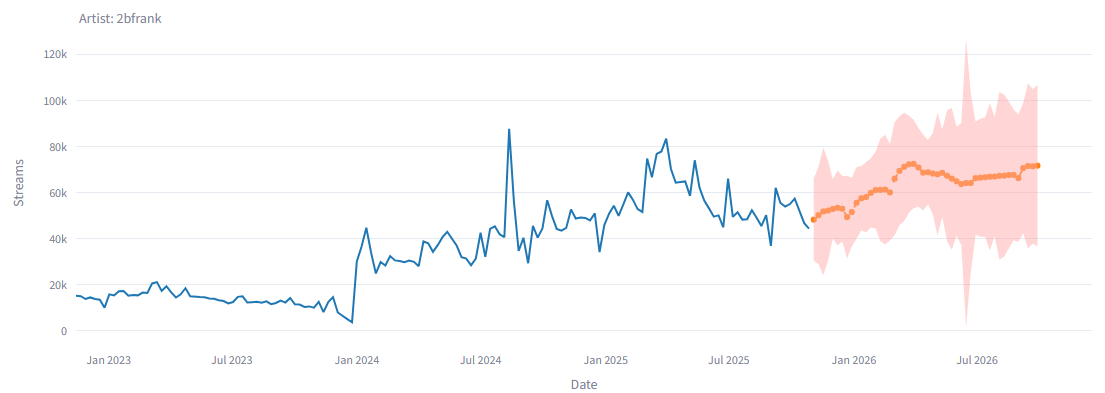
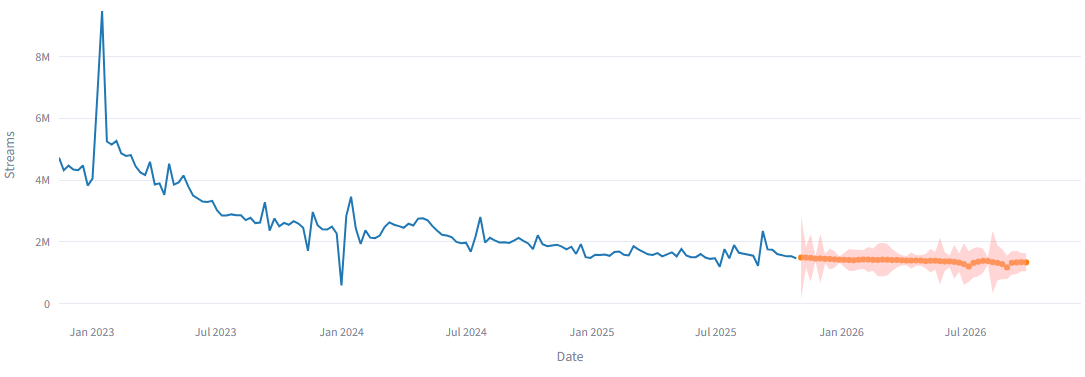
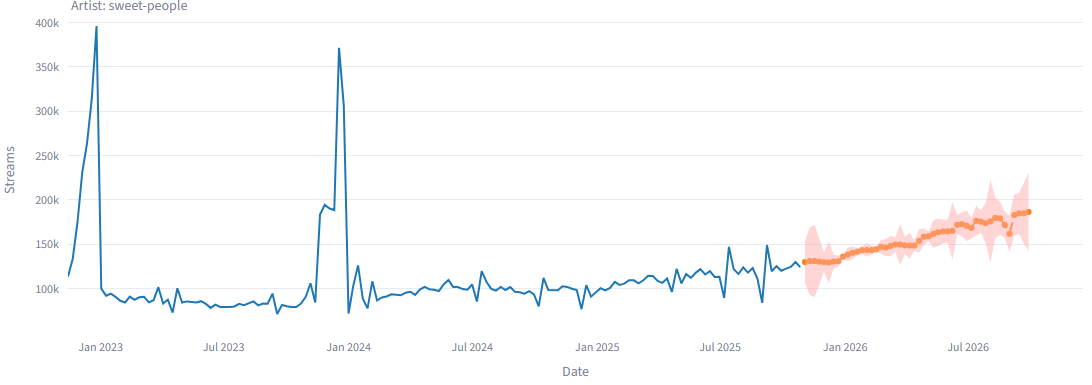
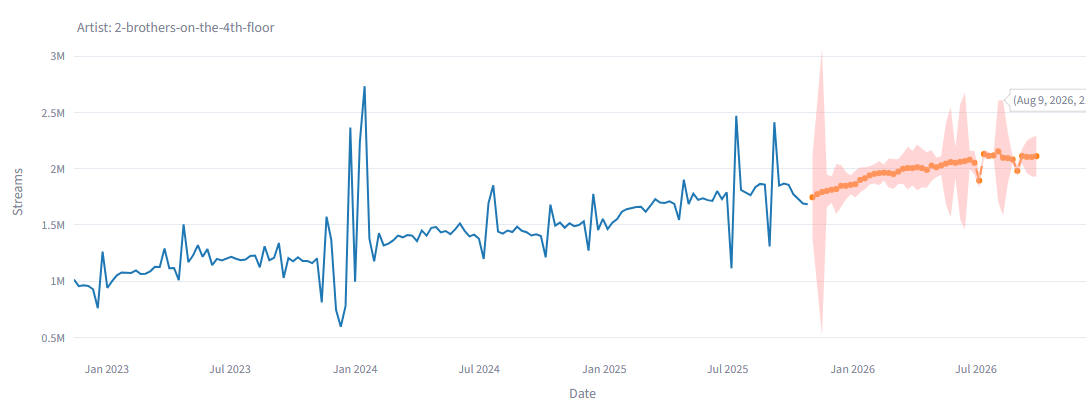
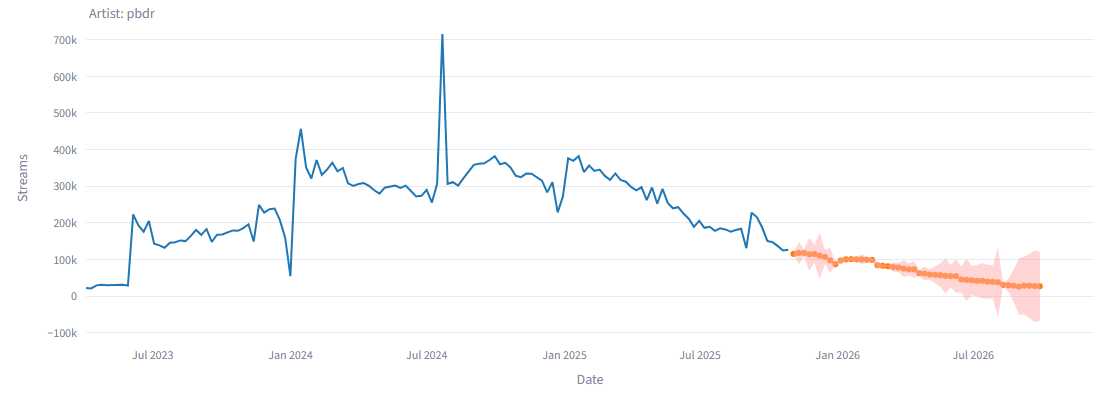
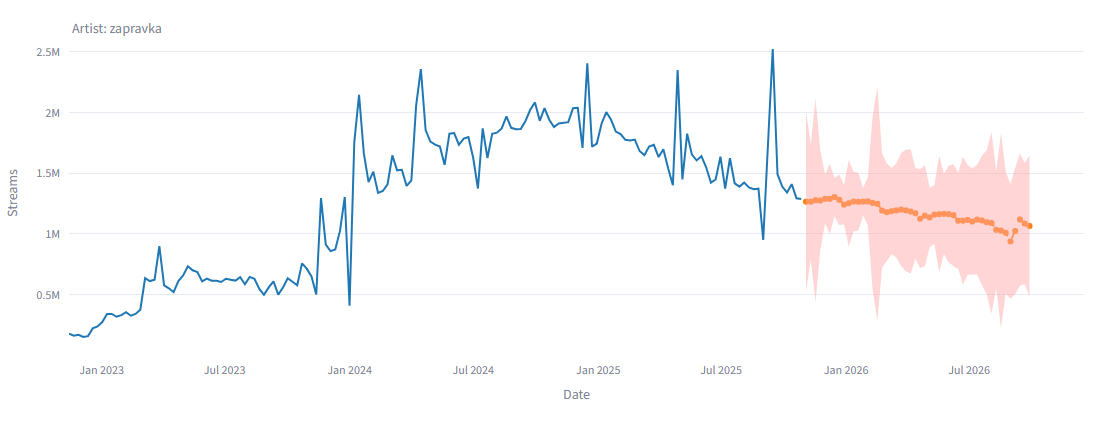
Figure 1: Steady Tendency with varianceFigure 2: Steady TendencyFigure 3: Increasing TrendFigure 4: PeaksFigure 5: Decreasing TrendFigure 6: Steady With High Variance
Interpretation of the resuts
Captures Steady Behaviour:Figure 1 and Figure 2 show how the model identifies a steady overall trend while also representing variability (signal flactuation) through wider or narrower confidence intervals.
Increasing Trends:Figure 3 and Figure 4 illustrate the model’s ability to forecast upward trends in streaming data.
They also highlight the influence of peaks: recent peaks (Figure 4) have a stronger impact than older ones (Figure 3).
Decreasing Trend:Figure 5 and Figure 6 show how the model successfully detects downward trends.
This is something a human analyst might easily overlook—especially in Figure 6—if relying only on raw historical data.
Action and Recommendations:
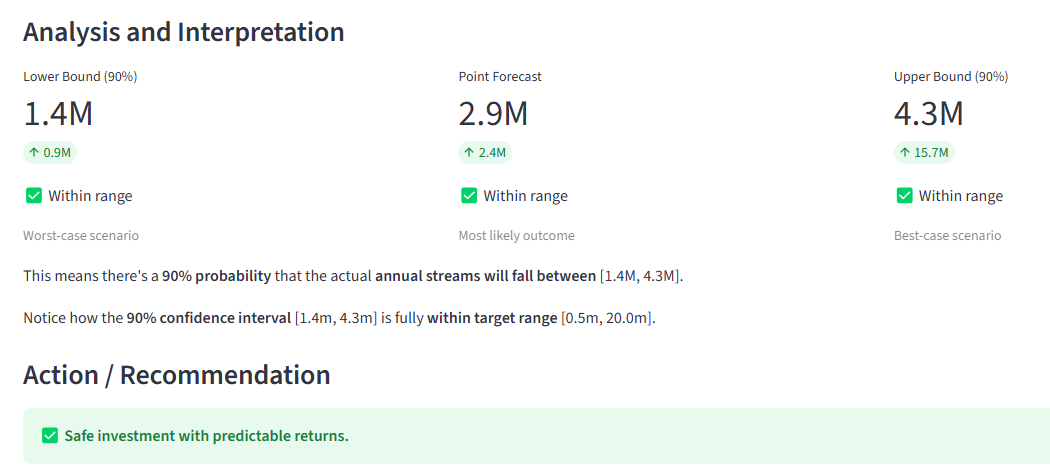
Figure 7: Recommendation for artist “2bfrank”
In the example shown in Figure 7, the artist 2bfrank (whose forecast corresponds to Figure 1)
is projected to reach approximately 2.9 million streams in the coming year.
The model estimates a 90% confidence interval between 1.4 million streams (worst-case scenario)
and 4.3 million streams (best-case scenario).
Because both bounds fall within our strategic target range of 500K to 20M streams, this artist is classified as a
🟢 High-Confidence Deal.
We therefore recommend moving forward with the investment, as the projected performance meets profitability expectations while
limiting competitive risk.
Other artists, such as pbdr (Figure 5) and swee-people (Figure 3), also fall within this category.
The remaining artists do not qualify, as their lower or upper bounds lie outside the target range—or, in some cases, both.
This methodology enables data-driven investment decisions based on probabilistic forecasts, ensuring that resources are
allocated to artists with the highest likelihood of achieving the desired streaming performance.
Investment Evaluation Framework:
🟢 High Confidence Deal: Both lower and upper confidence bounds within target range [500K, 20M]
🟡 Growth Potential Deal: Upper bound within range, but lower bound below 500K (higher risk, potential upside)
🔵 Competitive Premium Deal: Lower bound within range, but upper bound above 20M (safe floor, but expect competition)
🔴 Outside Target Range: Both confidence bounds outside desired range (doesn't fit investment strategy)
Key Application Features:
Interactive Artist Selection: Searchable dropdown with thousands of artists from the Viberate database
Historical Data Visualization: Interactive Plotly charts showing streaming history and trends
Customizable Forecasting: Adjustable prediction horizon (4-52 weeks) and confidence levels
Real-time Risk Assessment: Immediate investment recommendations with detailed justification